
The list of offered ESO projects for the 2025 IMPRS Program will be available at the end of August or the beginning of September. A selection of 4 to 5 projects will be offered.
The research activities at ESO focus on optical, infrared, and millimeter-wave astronomy, primarily using ground-based facilities at ESO observatories in Chile. In addition to optical and infrared imaging and spectroscopy, ESO astronomers are actively involved in developing and utilizing high-spatial resolution techniques such as adaptive optics and interferometry. Beyond these specific topics, the scientific expertise at ESO covers all major areas of astrophysics, including observational astronomy, modeling, and numerical simulations.
The research interests of ESO's science staff range from the Solar System to studies of the solar neighborhood (extrasolar planets, evolved stars, star formation), the interstellar medium, Galactic structure, galaxy evolution in the local Universe and at high redshift, the gas content of the Cosmic Web, and cosmology (galaxy clusters, Gamma-ray bursts, dark matter, lensing).
More details on science activities at ESO are available at
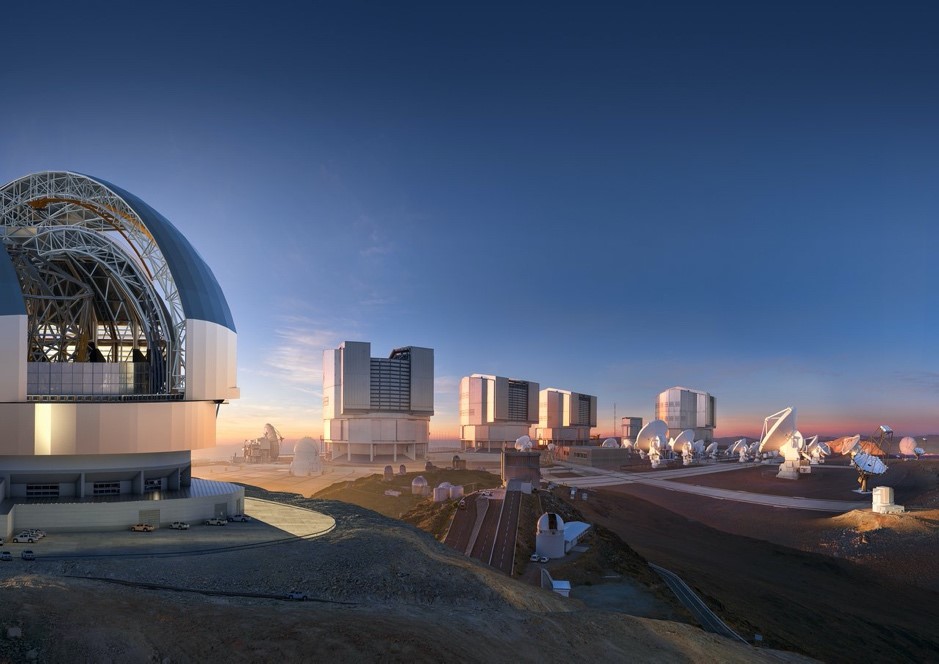
This collage shows ESO’s facilities in Chile from the La Silla and Paranal Observatories, merged into a single imaginary landscape. The forthcoming Extremely Large Telescope can be seen on the left, housing its giant 39-metre primary mirror; the 8.2-metre Unit Telescopes of ESO's Very Large Telescope are in the middle; and several of ALMA's 66 high precision antennas are on the right, along with antennas from the upcoming Cherenkov Telescope Array.