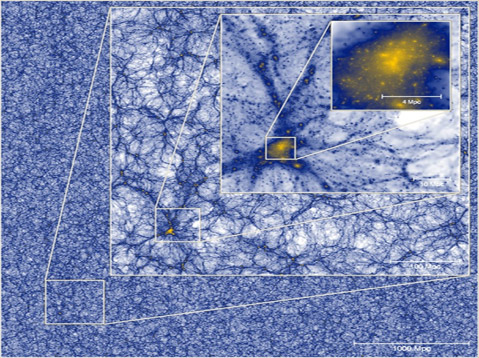
The MPA Cosmology group is interested in the structure, evolution and material content of our Universe. PhD positions can be offered in any (or a combination) of the following scientific topics which are currently under active study:
- The microwave background radiation as a probe of the origin of structure and the physics of the early Universe.
- Modeling and probing the intergalactic medium, with particular interest into simulations of reionization, radiative transfer and 21cm line observations.
- Modeling high-z galaxy formation and associated observables.
- The morphology, quantitative characterisation and observational measurement of the large scale structure in the galaxy, dark matter and intergalactic gas distributions.
- The use of gravitational lensing to constrain the nature of dark matter, the kinematic properties of high-redshift lensed galaxies and the presence of magnetic fields in lens galaxies.
- The structure, formation and evolution of galaxies and of their central supermassive black holes.
- The formation, fuelling and growth of supermassive black holes over cosmic time.
- The stellar populations of galaxies from the bulge to the outer halo.
- The structure and formation history of the Milky Way.
- The phenomenology of star formation in galaxies, of active galactic nuclei and of galaxy interactions, and its relation to the astrophysics driving the evolution of the galaxy population.
- The intergalactic and interstellar medium, its evolution and structure,
its chemical enrichment, its interaction with galaxies and AGN. - Using all of the above to test the current standard LCDM paradigm for the growth of cosmic structure, and to find tests for the nature of Dark matter and Dark Energy.
- Development of signal inference and image reconstruction methods based on
- information theory for galactic and extragalactic observations at various frequency bands ranging from radio to gamma rays.
Group members use a mixture of pure theory, high-performance numerical simulations, data interpretation, and direct observations to address these questions. The group is one of the principal nodes of the international Virgo Supercomputing Consortium which has carried out many of the largest cosmological simulations ever completed. It is a Partner in the Sloan Digital Sky Survey IV and PhD projects are availabe to use integral field unit (IFU) spectroscopy of 10,000 nearby galaxies to study stellar populations, kinematics and gas and star-forming properties of galactic bulges, disks and halos.
The MPA is also involved in the the Prime Focus Spectrograph Galaxy Evolution Survey on the Subaru Telescope. This 130-night program will capitalize on the wide wavelength coverage and m assive multiplexing capabilities of PFS to study the evolution of typical galaxies from cosmic dawn to the present. From Lyman alpha emitters at z~7 to probe reionization, drop-outs at z~3 to map the inter-galactic medium in absorption, and a continuum-selected sample at z~1.5, this program will chart the physics of galaxy evolution within the evolving cosmic web.
With the MPA High Energy group it is the German centre for the Planck mission which is currently mapping the microwave background radiation. It has built a remote station for the radio interferometer Low Frequency Array.