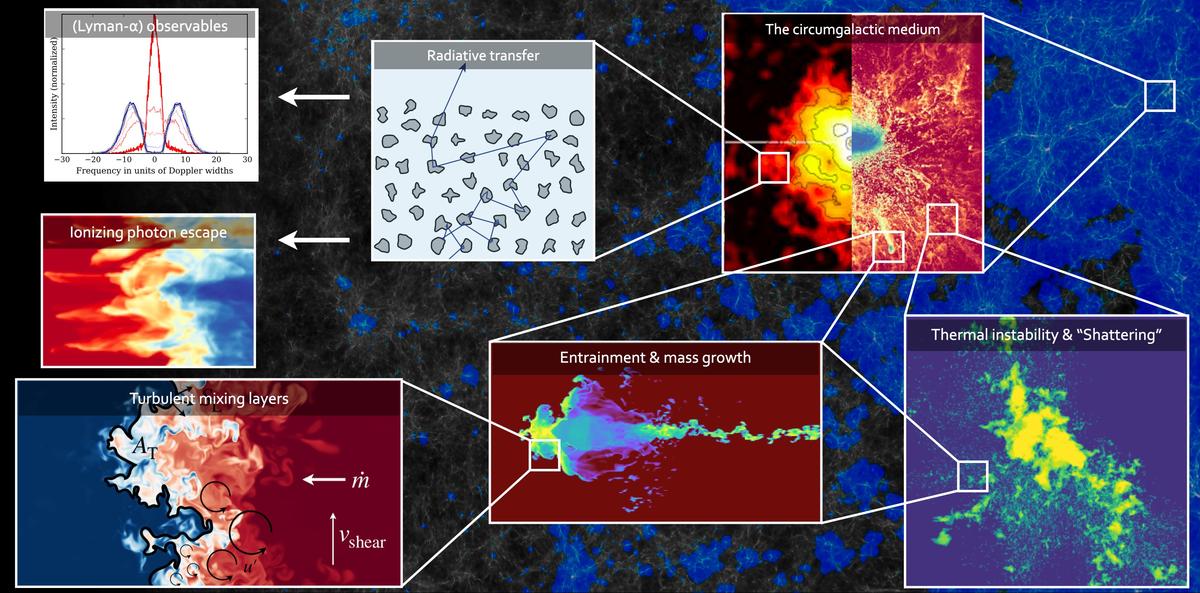
The Universe is filled with multiphase gas, that is, different gas with extremely different temperatures is often found co-spatially within and around galaxies. Understanding its dynamics and observables is at the heart of our understanding how material flows in and out of galaxies to eventually form stars, planets and everything we see around us. Famous examples of multiphase gas are the interstellar medium (ISM), circumgalactic medium (CGM), galactic winds and the intracluster medium (ICM).
In the "Multiphase Gas" research group, we use theoretical and computational methods to understand these systems and how we can observe them. In particularly, active research (in which we offer PhD projects) is being done in trying to answer:
- how does turbulence affect the evolution of multiphase gas and vice-versa?
- how do the different phases form, grow, or get destroyed?
- in what way does radiation propagate through a multiphase medium?
- how are the physical properties of multiphase gas imprinted on observable data?
- in which ways do multiphase gas flows affect galaxy evolution?
In the group, we develop new theories and write our own codes / numerical tools which we typically run on supercomputers. For more information visit our
webpage or reach out to our group members.